EYLF: The Early Years Learning Framework Explained
The Early Years Learning Framework (EYLF) curriculum was designed to support the development of children from birth to five years of age, before commencing primary school.
At Raising Stars, we believe that early childhood is a crucial period of time for children’s development and learning, and that every child should have the opportunity to receive quality early education. This is why the EYLF plays an integral part within our approach to childhood education and care.
Here is our comprehensive guide to the Early Years Learning Framework.

What is the Early Years Learning Framework (EYLF)?
The Early Years Learning Framework is a component of the National Quality Framework designed to foster a supportive and nurturing environment where children can be educated and cared for.
Developed in 2009 and updated in 2022, the framework was created as the Australian Government recognised the importance of early childhood development. Within this, they wanted a training providers strategy for all Australian children to receive equitable development, focusing on a successful transition into primary school.
As part of the NQF, the EYLF applies to child care services that include OOSH (out of school hours) care, family day care, long day care, preschool, kindergarten, and early learning centres such as Raising Stars.
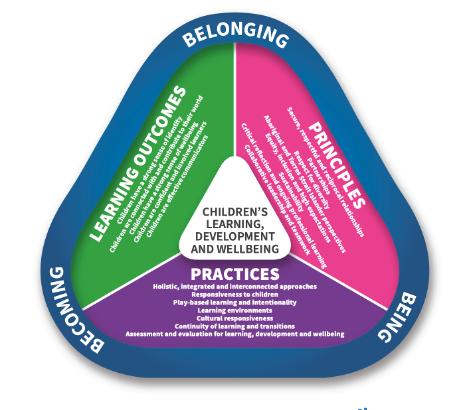
Themes of the EYLF: Belonging, Being and Becoming
The Early Years Learning Framework is represented by a triangle diagram. On the outside are the themes, or the ‘lenses’ through which the other aspects of the framework can be viewed through. These themes are:
- Belonging
- Being
- Becoming
Together, these themes facilitate foundations for children’s learning to meet the early years’ education standards.
Belonging
Belonging is the experience of knowing where and with whom you belong. Belonging is integral to human existence and children learn they belong to their family, a cultural group, their local community and other groups they associate with.
Belonging helps children define identities while recognising their interdependence and connections with trusted people. These connections further foster a sense of belonging that impacts the shaping of a child’s identity.
Being
Childhood is an important time to make meaning of the world.
The theme of being relates to children learning about the ‘here and now’ of life, not just planning for their futures.
Recognising the importance of the present moment is vital for childhoods to be as enriching as possible.
Becoming
Becoming reflects the development of children in their environment and how they are shaped by this through their childhood.
There are significant and swift changes that occur within childhood.
Becoming encourages children to actively participate in society so their knowledge, capabilities, skills, and connections with others can be fully formed.
These three core themes overlap the elements of the EYLF.
The Elements of the EYLF: Principles, Practice and Learning Outcomes
Within the EYLF themes, elements of the framework consist of an interwoven relationship between Principles, Learning Outcomes, and Practice. They are broken down into the following:
- Eight EYLF principles
- Five EYLF learning outcomes
- Seven EYLF practices
Lets take a closer look at each of the elements of the early years learning framework, and how they work together.
What are the EYLF Principles?
The 8 EYLF Principles are as follows:
- Secure, respectful and reciprocal relationships
- Partnerships
- Respect for diversity
- Aboriginal and Torres Strait Islander perspectives
- Equity, inclusion and high expectations
- Sustainability
- Critical reflection and ongoing professional learning
- Collaborative leadership and teamwork
These principles have been built upon contemporary theories and research including:
- Socio-cultural theories emphasising families and cultural groups as central roles in children’s lives and fostering respectful relationships within these groups
- Developmental theories with a focus on the rapid changes children experience and their ability to hone learning skills
- Socio-behaviourist theories focusing on the experiences of the impact can have on shaping the behaviour of children
- Critical theories inviting early childhood educators to think critically about the curriculum itself, and how children can be affected by decisions
- Post-structuralist theories to contemplate power, equity and social justice in the varied early childhood settings
The principles are also designed around pedagogy. Pedagogy refers to specific methods or practices of teaching, and in these circumstances refers to the early childhood pedagogy of holistic education. The professional practice of EYLF involves building and fostering relationships not only between the educator and children but also between the educator and the families of the children.
The 2022 update to the EYLF 2.0 also introduced a greater emphasis on equity, inclusion, and First Nations knowledge systems.
As such, the Principles, in conjunction with pedagogical practices, offer children and their families a continuing connection to their learning and development; as well as the educators providing these experiences.
Principle 1: Secure, respectful and reciprocal relationships
Relationships help to support the development of a strong sense of wellbeing for children. When children have secure, reciprocal and respectful relationships with their families, educators and mentors, and peers, their wellbeing will be elevated and quality of life will increase.
Research has proven that babies generate their first attachments with their families, and also facilitating trusting relationships beyond the family unit further enhances the secure foundations required for learning and exploring.
When children have an extended network of trusted people in their lives, their confidence boosts and they experience more value and respect. They can acknowledge these feelings within themselves and others, leading to more positive interactions.
The EYLF V2.0 strengthens this principle with a renewed focus on relational and place-based approaches to teaching, recognising the importance of culturally safe, emotionally consistent relationships for healthy brain development.
Families are the most influential teachers for children. They are their primary contacts and educators and carers need to work in partnership with the children’s families.
When this partnership exists, the early years learning framework learning outcomes are more likely to be achieved. Learning exists outside of the classroom and through positive partnerships, children have the opportunity to explore things in their everyday lives to further their learning.
The EYLF V2.0 increases the focus on shared decision-making, trauma-informed practice, and protecting children’s privacy and safety, including around digital technologies and online safety.
Principle 3: Respect for diversity
Respecting other beliefs and practices, especially those of the children’s families, is very crucial for children’s success. Every child is born into a culture shaped by family traditions, heritage and community values, and educators are asked to reflect those histories, languages, beliefs and lifestyles in their practice.
Diversity is positive for enriching communities and teaching children that there are many different examples of diversity within their everyday lives. This principle focuses on ensuring cultural safety and challenging unfairness alongside the importance of understanding Aboriginal and Torres Strait Islander perspectives.
Principle 4: Aboriginal and Torres Strait Islander perspectives
Aboriginal and Torres Strait Islander beliefs and practices about knowing and being should be promoted to generate wider understanding, especially from a young age. This principle requires educators to embed First Nations knowledge, culture and history into their everyday philosophy and practice, regardless of whether Aboriginal or Torres Strait Islander children and families are enrolled at their service.
The EYLF 2.0 was updated to include this principle in support of Reconciliation and Closing the Gap commitments, and gives every Australian child the opportunity to learn about the culture’s deep connection to Country.
Principle 5: Equity, inclusion and high expectations
Educators must recognise that all children deserve equity because they all have the capacity for success. Circumstances and abilities should not hinder a child’s ability to learn and grow, and educators need to address any barriers a child might be facing.
Through finding equitable avenues for alternate pathways, children can succeed in a way that is best suited to their needs.
Educators must recognise the importance of educating children about their role in caring for the planet and each other. This principle focuses on environmental, social and economic aspects of sustainability to shape foundational learnings across nature conservation, social justice and intergenerational equities.
Through teachings and learning opportunities around sustainability, children gain an interest in and ability to act in supporting a fair and sustainable world.
Principle 7: Critical reflection and ongoing professional learning
Educators should constantly work on developing and improving their professional knowledge and skills to help facilitate a deeper learning connection with the children they work with. Examples of ongoing professional learning include mentoring, research, further study and professional conversations.
Through reflective practices, educators can be informed more holistically about their educational practices and how they can better support the children’s learning. Questions for educators to reflect upon can include what they know about each child, what theories can assist their work, what challenges them, and what can be improved if the theories they use do not assist every child.
Principle 8: Collaborative leadership and teamwork
Educators must exercise leadership and teamwork to improve the quality of educational programs, practices and outcomes for children. This principle recognises the importance of effective leadership in early childhood education and the relationship between effective leadership and outcomes for children.
The responsibility of collaborative leadership and teamwork extends beyond formal leadership positions to educators at all levels. Through contributions to curriculum decisions and Quality Improvement Plans, professional accountability, and the communication of ideas, educators work to deliver the best outcomes for children and families.

What are the EYLF Practices?
The following practices support the learning outcomes, offering an enriched early childhood learning experience.
There are 7 EYLF Practices:
- Holistic, integrated and interconnected approaches
- Responsiveness to children
- Play-based learning and intentionality
- Learning environments
- Cultural responsiveness
- Continuity of learning and transitions
- Assessment and evaluation for learning, development and wellbeing
Practice 1: Holistic, Integrated and Interconnected Approaches
- Recognises connectedness of mind, body and spirit
- Educators aware of physical, personal, social, emotional and spiritual wellbeing in conjunction with their cognitive learning
- Learning is interconnected and holistic approaches allow for integration
- Learning is viewed as a social activity and collaborative learning is encouraged
Practice 2: Responsiveness to Children
- Being responsive to children’s strengths, abilities and interests
- Educators build upon existing strengths, abilities and interests shown by children
- They develop these qualities and respond in ways that align with the children’s individual needs, including respecting family traditions and values
- Open-ended questions are valued as they can provoke more ideas and interests to be expressed by children
- Providing feedback and challenging thinking is also a component of responsiveness
Practice 3: Play-based Learning and Intentionality
- Play lets children be creative, make discoveries, use their imagination, and improvise
- Social groups form through play, and children are free to simply be
- Children actively engage together during play, supported by positive reinforcement from educators
- Educators bring intentionality – deliberate, purposeful teaching that builds children’s skills
- Learning occurs through social contexts, with worthwhile, challenging experiences fostering high-level critical thinking
- Educators plan for intentional teaching opportunities, customising strategies to each child’s needs
Practice 4: Learning Environments
- Creating a variety of learning environments, both indoor and outdoor
- Spaces for learning should be welcoming, vibrant and flexible
- Families should be able to contribute their ideas to these spaces if they wish
- Outdoor learning spaces are important for connecting with nature and the wider learning environment
- Play spaces should include plants, trees, edible gardens, mud, water, rocks, sand and other natural elements
- They invite open-ended interactions, discovery, opportunities for connection with nature and safe risk-taking
- Outdoor learning creates a deeper appreciation for the natural world
Practice 5: Cultural Responsiveness
- Respecting other cultures is vital for children to learn
- This is a continuous two-way relationship between the educators, children’s families, and their wider community
- Educators are committed to developing their own cultural competence as well as facilitating children’s ability to understand, communicate with, and effectively interact with individuals and groups of people from varied backgrounds
- Having an awareness of your own worldview and acknowledging others’
- Having positive attitudes regarding cultural differences, seeing it as beneficial to society
Practice 6: Continuity of Learning and Transitions
- Recognising the learning transitions between different settings
- Transitions can be challenging but these are opportunities for growth
- Children have an active role in preparing for transitions
- Traditions, routines and practices of new settings can be taught
- Educators and families can commit to sharing information about transitioning from different settings (e.g. preschool to Kindergarten)
- Building on prior learning to facilitate further growth
Practice 7: Assessment and Evaluation for Learning, Development and Wellbeing
- Assessing and evaluating children’s progress in learning alongside wellbeing
- Analysing information and evidence to help understand where children are in their learning and development
- Ongoing cycle of planning, testing, documenting and evaluating
- Identifying where children need extra support through inclusive practices
- Allocating different resources to children to meet their varied learning needs
- Reflections on pedagogy for early childhood learning and development

What are the EYLF Learning Outcomes?
The Themes, Principles, and Practices are all designed to facilitate successful achievement of the Learning Outcomes.
The five EYLF learning outcomes are as follows:
Learning Outcome 1: A strong sense of identity
- Children feel safe, secure and supported
- Children develop their emerging autonomy, inter-dependence, resilience and sense of agency
- Children develop knowledgeable and confident self identities
- Children learn to interact in relation to others with care, empathy and respect
Learning Outcome 2: Connection to and contribution with their world
- Children develop a sense of belonging to groups and communities and an understanding of the reciprocal rights and responsibilities necessary for active community participation
- Children respond to diversity with respect
- Children become aware of fairness
- Children become socially responsible and show respect for the environment
Learning Outcome 3: A strong sense of wellbeing
- Children become strong in their social and emotional wellbeing
- Children take increasing responsibility for their own health and physical wellbeing
Learning Outcome 4: Confident and involved learners
- Children develop dispositions for learning such as curiosity, cooperation, confidence, creativity, commitment, enthusiasm, persistence, imagination and reflexivity
- Children develop a range of skills and processes such as problem solving, enquiry, experimentation, hypothesising, researching and investigating
- Children transfer and adapt what they have learned from one context to another
- Children resource their learning through connecting with people, place, technologies and natural and processed materials
Learning Outcome 5: Effective communicators
- Children interact verbally and non-verbally with others for a range of purposes
- Children engage with a range of texts and gain meaning from these texts
- Children express ideas and make meaning using a range of media
- Children begin to understand how symbols and pattern systems work
- Children use information and communication technologies to access information, investigate ideas and represent their thinking

The EYLF and the National Quality Framework
The Early Years Learning Framework is an integral element of the National Quality Framework (NQF).
What is the National Quality Framework (NQF)?
The National Quality Framework (NQF) is Australia’s regulatory system for early learning and school-age care. The NQF includes legislation, national quality standards, sector profiles and data, and comprehensive learning frameworks.
The Early Years Learning Framework represents one aspect of the National Quality Framework (NQF), thus aiding in the regulation and quality assessment of early learning and child care services.
The role of EYLF within the NQF is to set a mandatory standard for education across Australia. As education falls within the responsibilities of individual States and Territories, the NQF and EYLF ensure that children across Australia are receiving the same early learning education and care experiences.
EYLF Developmental Milestones: Assessing Children’s Play and Learning
Developmental milestones are assessed between the following ages of young children:
- Birth to 4 months
- 4 to 8 months
- 8 to 12 months
- 1 to 2 years
- 2 to 3 years
- 3 to 5 years
Each category provides the developmental area to focus on, physical, social, emotional, cognitive, and language. There are observations for each area and also suggestions for when it would be recommended to seek advice from a paediatrician.
For further information, you can read the Developmental Milestones guideline here.

How the EYLF is Implemented by Child Care Providers and in Early Childhood Education
Child Care Providers must follow the framework and guidelines to ensure children receive a high-quality educational experience, in accordance with Australian-wide policy.
Educators are trained to incorporate the framework into their teachings and regularly use the framework as the foundation for their teaching practices.
Play-based learning
Play-based learning is of crucial importance because it recognises that children learn not only in traditionally intellectual environments but also develop cognition through activities like play.
The framework encourages play that involves problem-solving and social interaction, to build on the three key themes of the framework.
The EYLF at Raising Stars Early Learning Centre
At Raising Stars, we go above and beyond to ensure that the Early Years Learning Framework shapes our approach to early childhood education in the most effective way possible.
Our approach has a strong focus on well rounded, play based education for children, social and emotional development, school readiness, and research based childhood education and care.
How Families Can Implement the EYLF Within Their Child’s Education
The framework can be implemented by families in their child’s education both within the home environment and in other settings like day care and pre-school, or in social interactions with other children.
The Future of the Early Years Learning Framework
The future of the framework is unknown, however, there have been various suggestions for its development:
- Analysing how play, identity and language evolves and incorporating various observations, assessments and regulatory planning
- Investigating digital technologies and the emergence and presence of these in children’s lives, and how they can be included appropriately for a positive benefit of their development
- An integrated approach to STEM – Science, technology, engineering and mathematics; or even STEAM, which incorporates Arts.
- A varied learning trajectory to mirror the differing needs of children, acknowledging that not all of them learn at the same pace
Early Years Learning Framework Resources
For more information and resources about the early years learning framework, check out some of the links below!
Australian Children’s Education and Care Quality Authority (ACECQA):
- ACECQA: The Early Years Learning Framework for Australia
- ACECQA: Developmental Milestones in the EYLF and NQF
- ACECQA: The NQF
The Department of Education, Skills and Employment (DESE):