

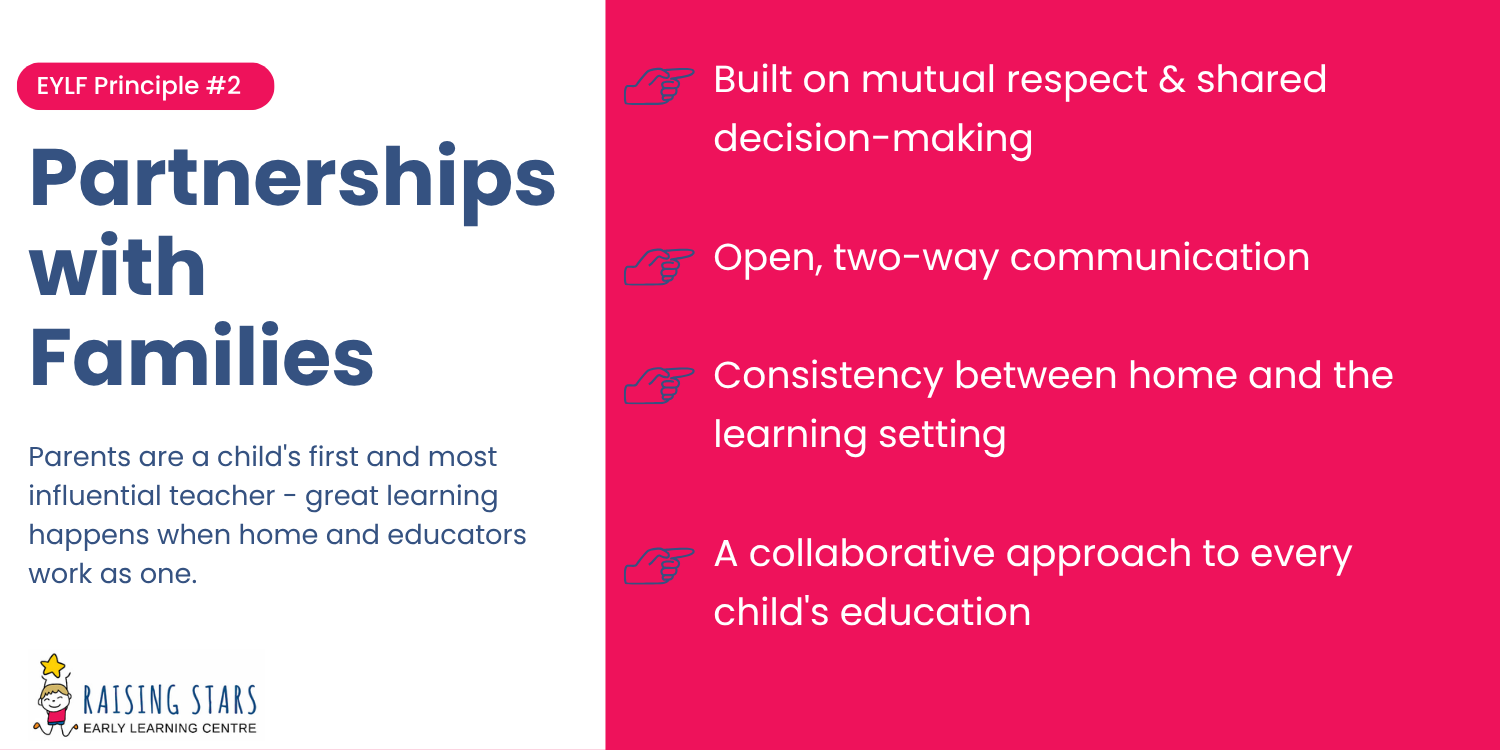
The Early Years Learning Framework (EYLF) Principle #2 dictates that educators work in collaborative partnerships with families. It acknowledges that parents are a child’s first and most influential teacher. The parent-teacher relationship is built on mutual respect, shared decision-making, and open communication. This creates a collaborative approach to education, ensuring consistency between home and the early learning setting.
Why Family Partnerships are essential for early development
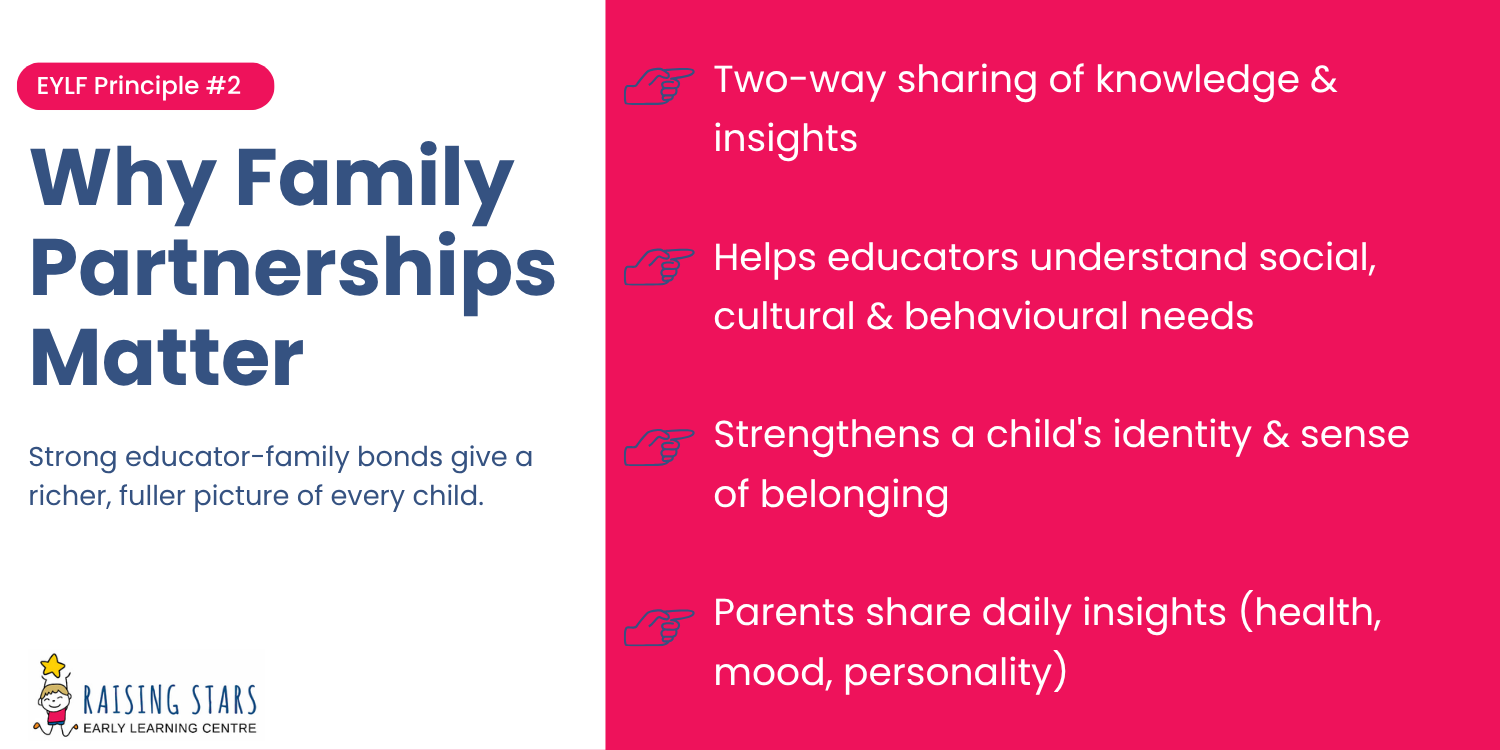
Family partnerships are essential for early development because a collaborative approach to education greatly enhances learning outcomes. Good relationships between educators and parents provides two-way sharing of knowledge and insights about the child. It enables the teacher to better understand the social, cultural and behavioural elements of a child, while also allowing them to confidently share with the parent their own observations from classroom scenarios. The teacher will also be better equipped to address the individual needs of the student, while the parents or carers will be able to assist with uniformity between home and the early learning setting.
What Makes a Collaborative Partnership with Families?
The best learning experiences for children occur when it is evident in the educator’s daily practice that there is a strong relationship between them and the child’s family. There’s no denying that the relationship with each family will be unique in various ways, but all partnerships should share some key features. The foundational elements are:
Mutual Trust
Both the educator and the family need to be confident in each other’s shared goal of providing the optimum learning environment for the child.
Open, Respectful Communication
All interactions need to be honest and respectful of each other and the roles the two parties play in the child’s development. Being respectful requires an understanding of social and cultural diversity and the different ways in which people interpret communications.
Empathy & Openness to Different Perspectives
It’s important to understand that people think in different ways and have varying beliefs and perspectives on what is best for a child. By both the family and educator being open to different ideologies, customs and methods, it is possible to be more collaborative in the approach to a child’s care.
Shared Decision-Making
As often as practical, it’s ideal that the decisions made about what occurs in the learning environment and how to manage the care and educational needs of a child, are agreed upon mutually between the family and educator. By sharing in the decision-making process, all parties are more likely to embrace the outcomes.
Clarity of Roles & Responsibilities
There must be clear delineation between the roles and responsibilities of the carer and those of the family of the child. While there will be overlap in some of them, other duties will be specific to the individuals.
Willingness to Negotiate & Resolve Conflict
There may be times when conflicts may arise. In these situations, all parties must be willing to co-operate to ensure a swift and positive resolution.
Shared Goals for the Child
At the end of the day, the educator/carer and family should all have clearly defined goals that all parties share and support.
Why Partnerships with Families Matter
As the EYLF makes clear, partnerships between educators and families matter, so while forming partnerships is not always easy, they are always worth the effort.
For a child, knowing that you respect their family strengthens their identity and sense of belonging while enhancing their learning. Also, to better understand a child and the way they behave, an educator needs to know the family and the cultural and community contexts of their lives. These elements have a significant impact on how the child learns and what they need to feel valued and safe.
Finally, families – parents in particular – bring valuable insights that offer a richer picture about their child. Parents can provide information on a daily basis with things like current health or level of fatigue, and also in a greater sense with an understanding of the child’s personality or what they do and don’t respond well to.
Practical Strategies for Building Family Partnerships
Starting Strong: First Interactions & Enrolment
First impressions last, so carers should start building a feeling of welcome and respect from the initial interaction they have with families. Enrolment and orientation procedures should communicate messages about partnership, and educators should let families know that they are keen to know what they want for their child. At this point and ongoing through the relationship, it’s important to encourage families to contribute to the curriculum.
Offering Varied Ways for Families to Contribute
There will be different levels of involvement that families will be either capable of, or willing to provide. Therefore, there should be a variety of ways for families to be involved in and contribute to the service, if they choose to.
Communicating Across Multiple Channels
Conversations are the best way to communicate, however it may not always be possible. Centres and staff should communicate with families in different ways: written, electronic, and verbal.
Creating a Welcoming Physical Environment
Ensure that the physical environment is welcoming to both children and their families by having evidence of the families’ lives. Invite children and their families to share photos of themselves and bring items from home for show and tell or other sharing scenarios.
Sharing Positives & Handling Concerns Thoughtfully
Carers should share with families anything positive about their child. On the flipside, careful though should be given about if, when and how to share concerns.
Connecting Families to Other Services & Support
Centre staff should have strong connections with other organisations and service providers that are able to provide support for families and the child should it be required. Carers should be able to help families to access these when needed.
Final Thoughts
Ultimately, partnerships between children, families and carers involves establishing a sense of community, with shared goals and open communication. All parties should feel like they belong and their contributions are valued. If families and children feel empowered, safe and confident, and centre staff are welcoming, caring and communicate clearly, then the foundations of strong connections will be laid.