

EYLF Principle #7, Critical Reflection and Ongoing Professional Learning, is a commitment by educators to regularly scrutinise and enhance their pedagogy (the method, manner, and overall science or art of teaching), beliefs, and practices through deep thinking, theory, and collaboration.
What Is EYLF Principle 7 – Critical Reflection and Ongoing Professional Learning?
EYLF Principle #7, Critical Reflection and Ongoing Professional Learning, is based on the principle of going beyond simple daily self-evaluation to question why educators work in particular ways and how assumptions impact children. The belief in lifelong learning is at the core, where educators actively pursue professional development, mentoring, research, and collaborative conversations to strengthen their capabilities. Also, this principle encourages educators to draw on the diverse viewpoints of colleagues, families, children, and community members, including Aboriginal and Torres Strait Islander Elders.
Links to the National Quality Standard (NQS)
EYLF Principle #7, Critical Reflection and Ongoing Professional Learning, has three key links to the National Quality Standard (NQS).
In connection to Quality Area 1: Educational program and practice, critical reflection focuses on Standard 1.3 (Assessment and planning) and specifically Element 1.3.2, where critical reflection drives program planning and implementation.
As per Quality Area 4: Professionalism, EYLF Principle 4 connects to Standard 4.2 through collaborative work practices, where educators support, challenge, and learn from one another to improve practice.
Another link to the National Quality Standards is in Quality Area 7: Governance and leadership, specifically standard 7.2. Educators seek continuous improvement, through effective self-assessment and a professional, positive learning culture.
Why Critical Reflection Matters in Early Childhood Settings
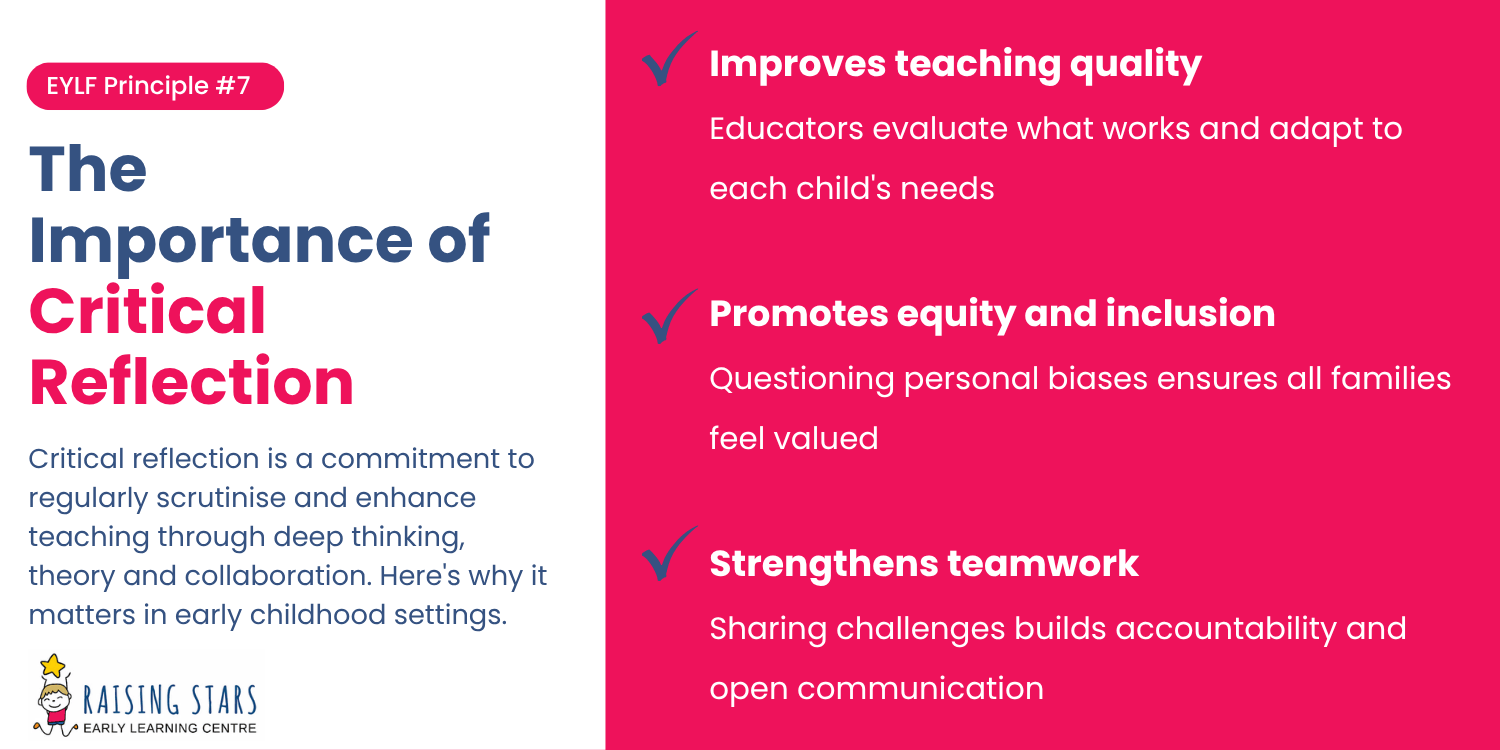
Critical reflection matters because it improves teaching quality by helping educators to evaluate what works and what doesn’t, moving beyond routine behaviours and adapting their methods to better support each child’s unique needs. It promotes equity and inclusion by encouraging educators and support staff to question personal biases, recognise power dynamics, and ensure all family structures and cultural backgrounds feel valued. When educators discuss challenges and successes together, critical reflection can also strengthen teamwork by building shared accountability and open communication.
What Critical Reflection Looks Like in Practice
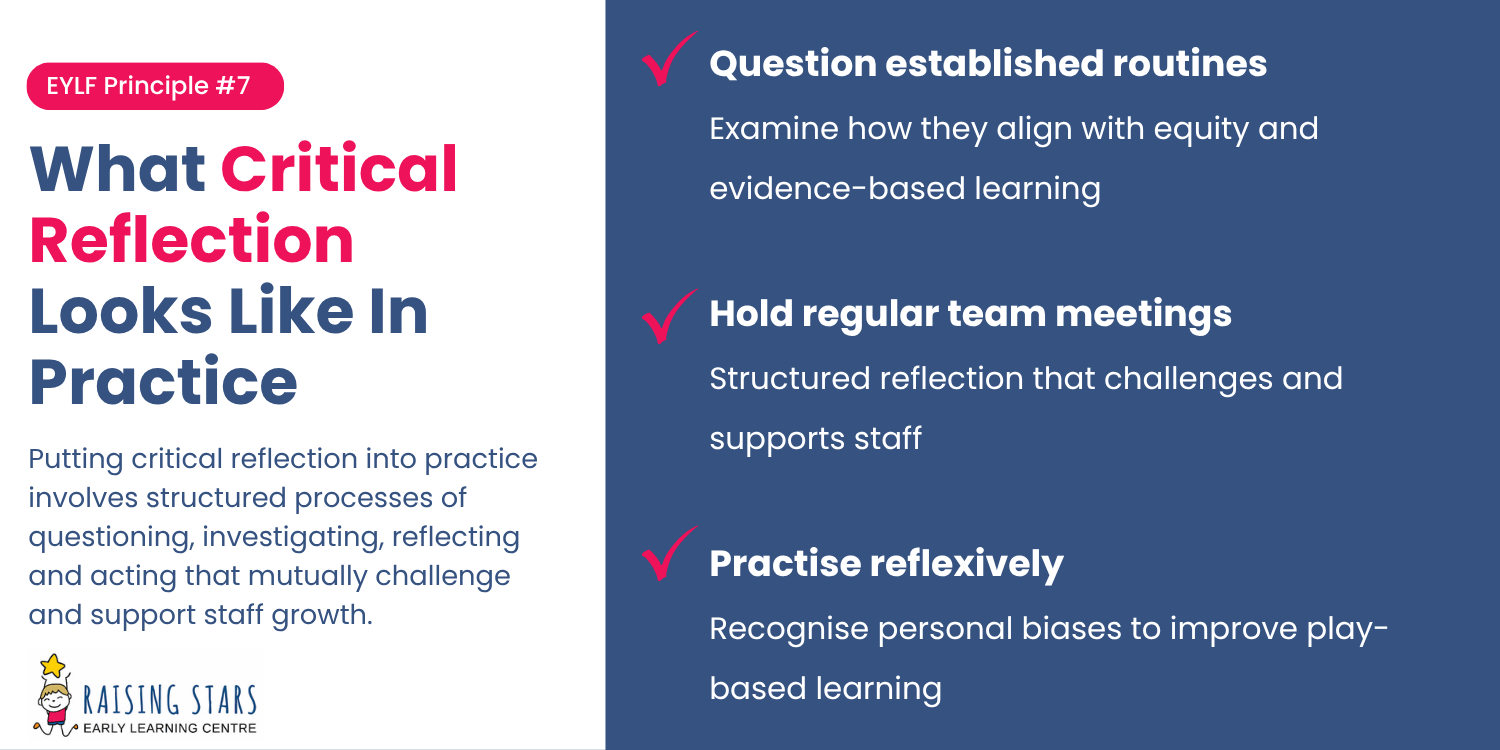
Putting critical reflection into practice involves processes like holding regular team meetings focused on iterative, structured processes of questioning, investigating, reflecting, and acting that mutually challenge and support staff growth. Actions that put critical reflection into practice includes questioning established routines and evaluating how they align with equity, wellbeing, and evidence-based learning, as well as engaging in reflexive practice to recognize personal biases and improve play-based learning.
Building a Culture of Ongoing Professional Learning
It is important within an early childhood setting that staff are encouraged to continuously aspire to grow, improve and share as educators and carers. By embracing critical reflection and ongoing professional development, staff can advance their skills and achieve transformational growth within the educational setting, shifting practice from routine compliance to deep professional inquiry.
Regular critical inquiry is a powerful tool for driving equity and social justice, as well as helping to prevent complacency by encouraging self-analysis and improvement. It can also aid educators in connecting theory to practice and helps staff to identify biases and assumptions that may influence their approach in a broad sense, but also to individuals. A culture of ongoing professional learning can also assist educators in identifying gaps in knowledge and foster collaboration between staff, families and the community.
Reflective Questions for Educators and Services
Educators and service providers should regularly look introspectively at how they conduct themselves, what their beliefs are, how they can improve and if they are engaging the broader community and other educators in their personal development and teaching methods.
The following questions form a foundation for critical reflection for educators and services:
- How much do I/we really know about each child?
- Is anyone placed at an advantage or disadvantage by my/our teaching methods and processes?
- How do I/we include children, families, and communities in practice?
- Do my/our beliefs create any bias towards particular children or groups?
- Am I/we providing engaging and inclusive activities?
- How do I/we use data and evidence to drive continuous improvement?
- What theories, philosophies, or frameworks shape our/my work?
Final Thoughts
Critical reflection is a multifaceted, continuous process where early childhood educators and services examine their actions, beliefs, biases, and teaching methods from various perspectives, with the goal of improving children’s learning and wellbeing.
By embracing critical reflection and ongoing professional learning, educators and services can foster ongoing development of staff, processes and practices to become better service providers with a focus on best practice, inclusivity, equity and collaboration within the early learning environment.