
EYLF Version 2.0 Principle 6 is centred around Sustainability. The guidelines state that educators must teach children how their actions affect the planet and each other across three interconnected dimensions: Environmental Sustainability, Social Sustainability and Economic Sustainability.
What Is EYLF Principle 6 – Sustainability?
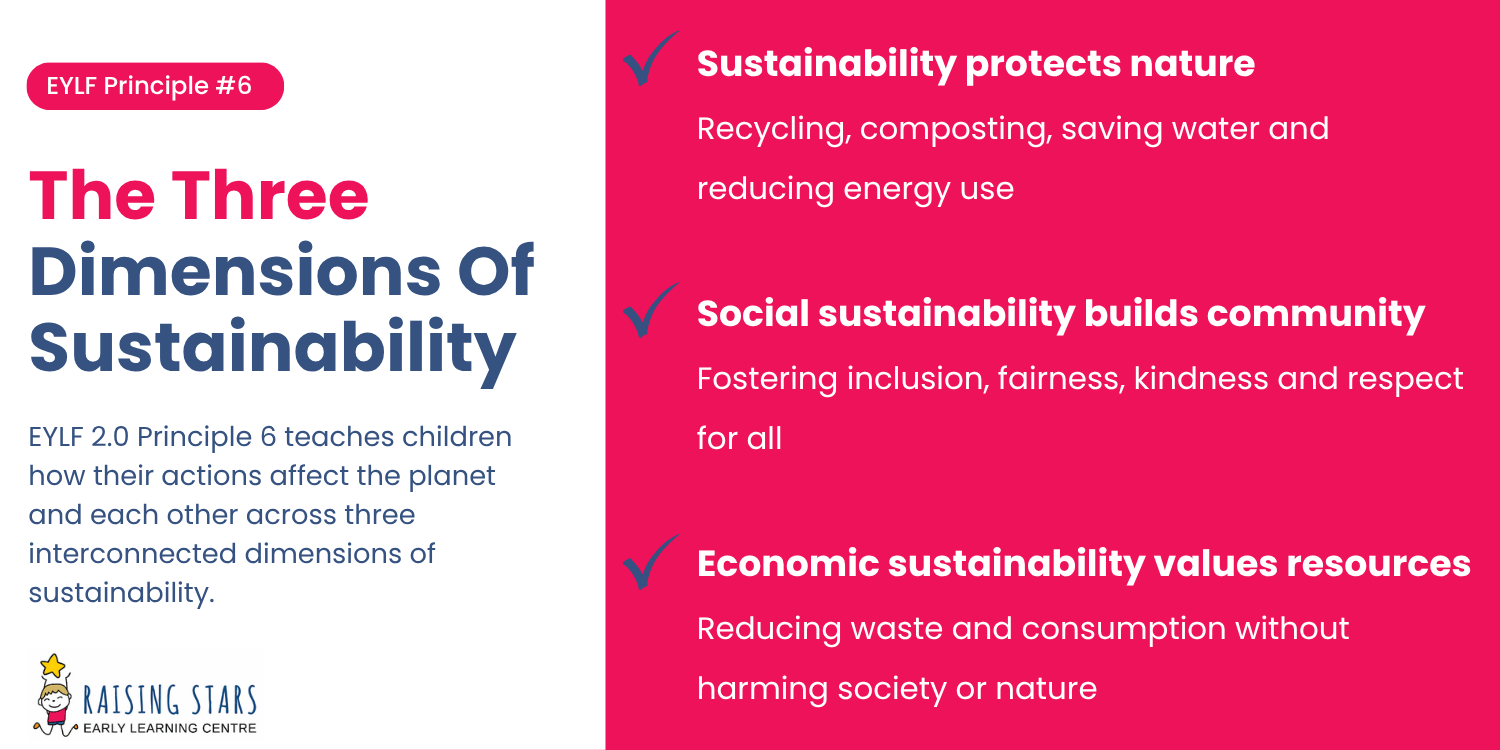
The Early Years Learning Framework (EYLF) 2.0 features Sustainability as one of the 8 principles that underpin practice. Sustainability is broadly defined to cover the intertwined dimensions of environmental, social, and economic aspects.
Environmental Sustainability refers to caring for and protecting the natural world through actions like recycling, composting, disposing of rubbish properly, minimising water waste and saving energy.
Social Sustainability is about fostering inclusion, fairness, equity, kindness, and respect to create peaceful and resilient local and global communities. Building a society with these elements at the core empowers all people to feel safe, valued and respected.
Economic Sustainability teaches children to adopt practices that support development and fair access to resources without harming society or the environment, such as reducing waste and consumption.
Links to the National Quality Standard (NQS)
The National Quality Standard (NQS) sets a high national benchmark for early childhood education and care, and outside school hours care services in Australia. When it comes to sustainability, the links to the NQS lie in 4 key areas.
Quality Area 1 (Educational Program and Practice) focuses on intentional teaching where educators thoughtfully incorporate sustainability concepts into learning. Quality Area 3 (Physical Environment) highlights environmentally responsible practices, supporting children’s exploration and embedded daily operations. Quality Area 6 (Collaborative Partnerships) involves community engagement to build sustainable initiatives and relationships. Quality Area 7 (Governance and Leadership) is guided by a clear service philosophy shaping sustainable operations.
Why Sustainability Matters in Early Childhood Settings
Sustainability matters in early childhood settings because it teaches children to develop into active, informed citizens who understand how human actions, nature, and society are interconnected.
Early childhood settings are where a child’s foundational attitudes toward stewardship, responsibility, and respect for living things are formed. These become lifelong values that encourage children to be active members of their community, giving them the knowledge and tools to be contributing voices in decision-making.
By learning about sustainability, it helps children realise they can influence positive, reasonable changes in their world. Children are taught how their choices extend beyond their community and can reach far wider. It also helps them understand interdependencies between people, animals, and resources.
What Sustainability Looks Like in Practice
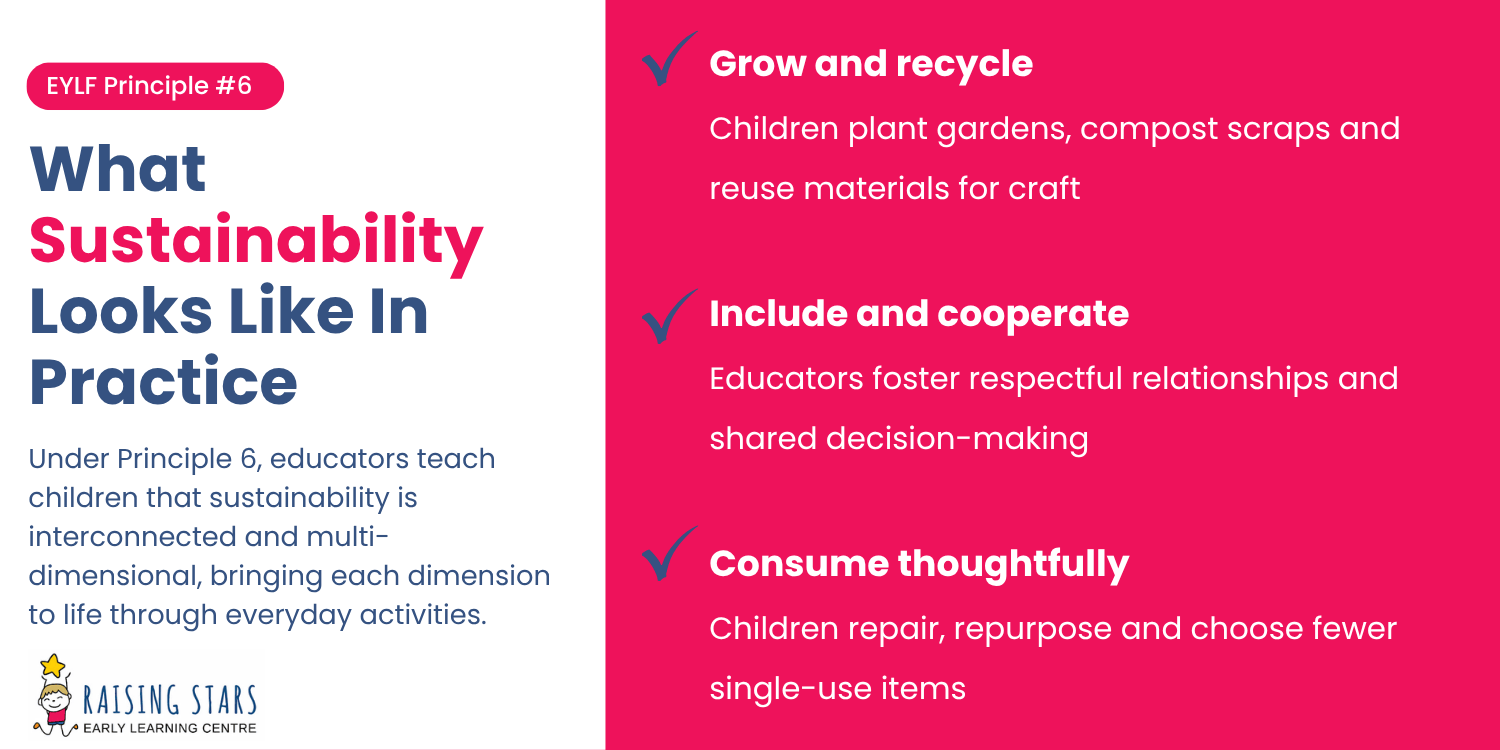
Under the EYLF V2.0 Principle 6 – Sustainability, educators teach children that sustainability is interconnected and multi-dimensional, spanning environmental, social, and economic aspects.
When put into practice, this may include environmental elements, such as growing plants or vegetables, mulching gardens, learning how to save water, composting and recycling items like boxes for use in craft. It can also include teaching children to be energy efficient by turning off lights and hanging out clothes instead of using a dryer.
Social sustainability can be taught by educators fostering inclusive, respectful relationships, equality, and cooperative play where all children feel they belong. Educators can also include children in group discussions and decision making in areas that affect their peers and environment.
The principle of economic sustainability can be taught through the concept of thoughtful consumption, such as buying fewer single-use items, fixing or repurposing broken things instead of discarding them, or making toys and other resources at home, rather than replacing them.
Sustainability Across Age Groups
| Age | Environmental Dimension | Social Dimension | Economic Dimension |
| Infants (0 to 12months) | At this age it is about sensory experiences, such as touching grass or plant leaves, smelling herbs or flowers, and exploring natural ‘treasures’ like colourful/smooth pebbles or seed pods. | Encouraging gentle, respectful interactions with educators and peers. | Making use of reusable items or wooden toys instead of single-use plastics during care and play. |
| Toddlers (1 to 3 years) | Using leftover water on garden beds, helping feed a worm farm, and learning to touch bugs and flowers gently. | Practicing the sharing of books and toys, and learning to take turns. | Turning off the tap when washing hands, guided by visual sequence cards. |
| Preschool (3 to 5 years) | Independently sorting food scraps and waste for compost and recycling. Teaching the life cycles in edible gardens and of butterflies. | Working as groups in projects and standing up for fairness in play. | Reusing old items for new purposes, and brainstorming ways to fix broken toys. |
Reflective Questions for Educators and Services
Early childhood educators and services should critically reflect on how they are applying the principle of sustainability by asking questions such as:
- How do we notice, capture, and nurture children’s natural curiosity about the environment?
- What are our personal beliefs about sustainability and the environment and do they impact our teaching?
- How can we reduce our use of single-use plastics?
- Before discarding something, do we look for ways to repair, repurpose, or upcycle it?
- What processes are in place to manage waste, water consumption, and energy efficiency?
- In what ways do we intentionally teach the concept of interconnectedness?
- How do our indoor and outdoor environments inspire and encourage children to appreciate, respect, and care for nature?
- How do we teach children about scarcity, sharing, and the value of looking after resources so they last?
- How are sustainable behaviours, such as composting, turning off taps, or recycling embedded as natural habits in our daily routine?
- Do we seek out and respect the diverse cultural views, values, and sustainable practices of all families in our community?
- Are we collaborating with local community groups, Elders, or environmental organisations to expand children’s social awareness?
- How are we teaching children that their actions today directly impact the world that future generations will inherit?
Final Thoughts
Considering sustainability entails envisioning the future and taking action to foster healthy, fair, and dynamic prospects for all. Sustainable practices should be formulated together with children, and motivate them to actively participate in environmental care to help achieve a sustainable future.
Teachers have a role in encouraging active citizenship, helping children to view themselves as responsible members of local and global communities who can support a healthy, safe and fair world. By teaching children how humans, animals, plants, lands, and waters depend on one another, they then see the more far-reaching implications of their actions, and how the interconnectedness of things means one action can impact many areas.