
EYLF Principles #1: Secure, respectful and reciprocal relationships
The Early Years Learning Framework (EYLF) is Australia’s national standard for early childhood education and care. Its full name is Belonging, Being and Becoming: The Early Years Learning Framework for Australia. It applies to all approved childcare and early education settings for children from birth to five years of age.
Secure, respectful and reciprocal relationships acknowledges that children’s experience of positive, caring connections and interactions with others plays a critical role in healthy brain development and socialisation.
What Does “Secure, Respectful and Reciprocal Relationships” Mean in the EYLF?
Within the EYLF, the principle of ‘Secure, Respectful and Reciprocal Relationships’ acknowledges that caring, consistent relationships with educators are the single most important factor in quality early learning. Children learn best when they feel safe, valued, and emotionally connected. This principle places relationship-building at the centre of every interaction.
Why Relational Pedagogy Matters for Children’s Learning and Development
Relational Pedagogy Matters for Children’s Learning and Development because children are biologically wired to learn through connection. They require positive, responsive interactions to build the neural pathways necessary for attention, curiosity, and emotional regulation.
Relational pedagogy is an educational approach based on the idea that meaningful connections between teachers and students are the primary vehicle for learning. It prioritises emotional safety, with deep, trusting, and reciprocal relationships between educators, children and their communities. It treats social connection as the foundation of learning. Rather than treating content delivery as the sole focus, it prioritises mutual respect, trust and care, which in turn improves student engagement and cognitive growth.
What This Looks Like in Everyday Practice
Culturally Safe and Responsive Interactions
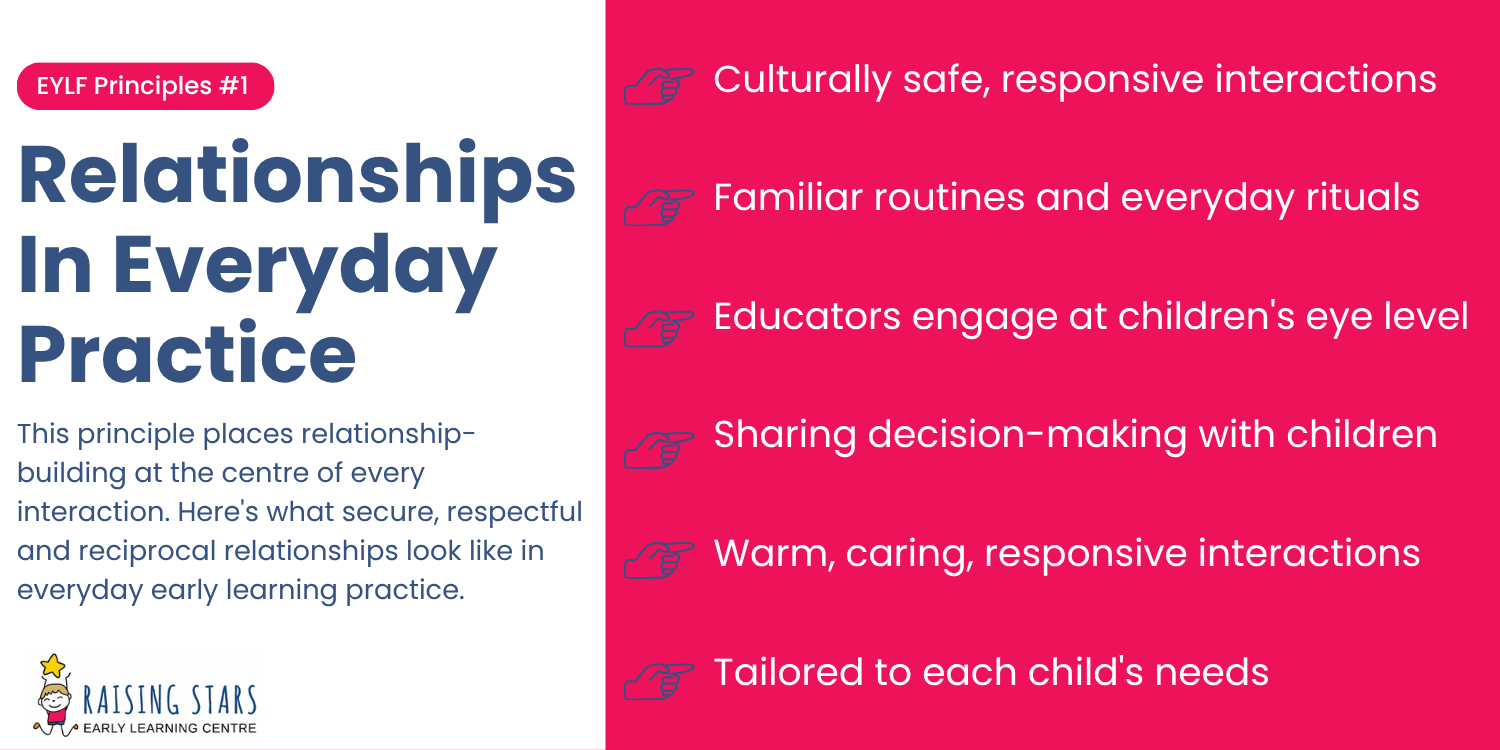
Educators actively prioritise nurturing relationships that respect the backgrounds, beliefs, values, customs, lifestyles and social behaviours of the different cultural backgrounds of the children. In a culturally safe environment there is no discrimination, challenge or denial of someone’s identity, and educators work collaboratively with culturally and linguistically diverse children and families.
Familiar Routines and Rituals
Familiar routines and everyday rituals, such as mealtimes, sleep/rest times, group times etc, are in place based on children’s preferences and the dynamics of the day. This ensures that children develop the abilities, skills and understandings they require for interacting with others. For example, self-regulation skills.
Educator-Child Engagement at Eye Level
Educators are at the children’s level, not standing over them. It’s important that they engage with them in a relaxed and unhurried manner, talking with children about what is about to happen during routines, rituals and transitions.
Sharing Decision-Making with Children
By actively engaging in each child’s learning and sharing decision-making with them, educators build nurturing relationships with each child that help them to feel valued as competent and capable individuals. Educators support children as they begin to empathise with others, to appreciate their connectedness and interdependence as learners, and to value collaboration and teamwork.
Warm, Caring and Responsive Interactions
Relationships between educators and children are meaningful with interactions being warm, caring, responsive and respectful. Educators’ ability to adjust and tailor their interactions is important to best support the differing ages, individual strengths, dispositions, confidence and varying capabilities of each child.
Secure, Respectful and Reciprocal Relationships Across Different Age Groups
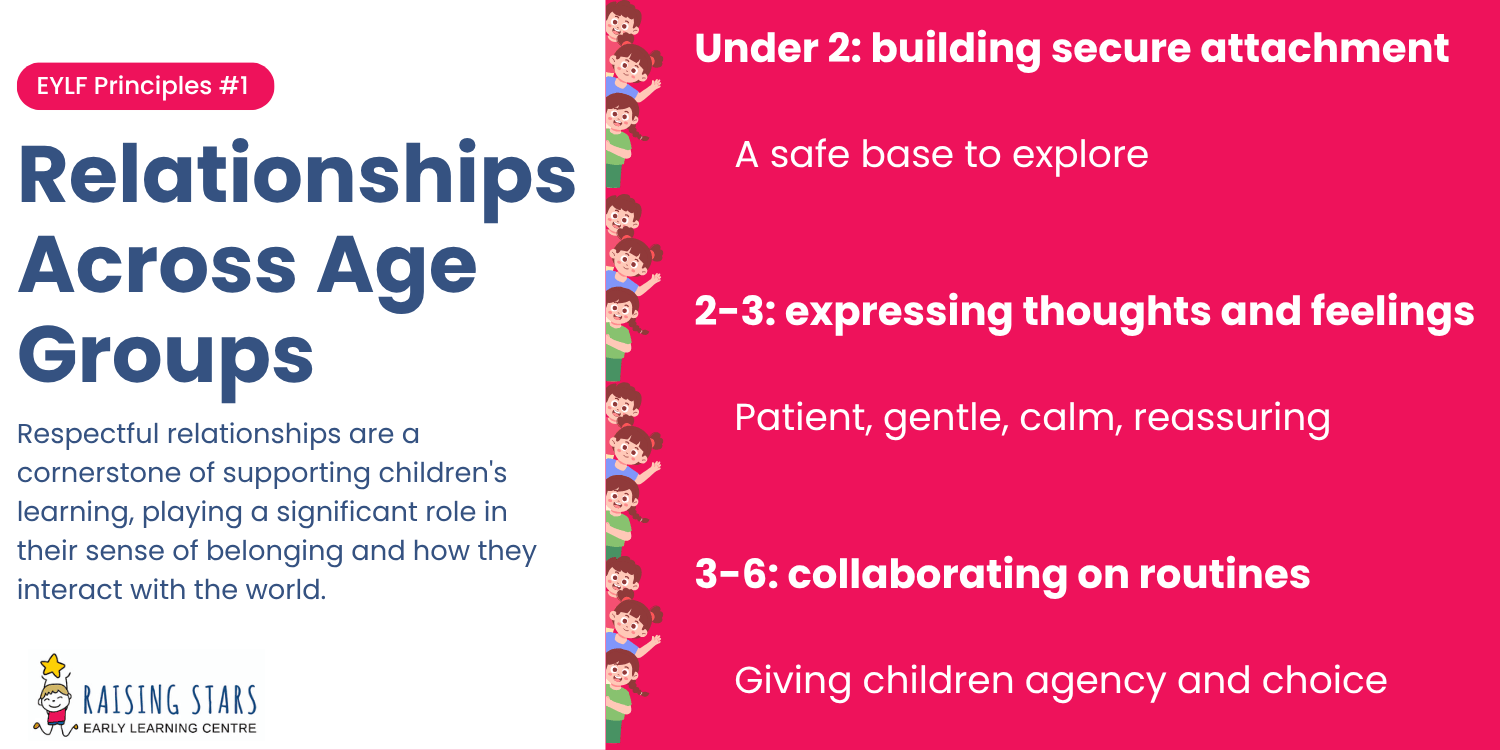
Respectful relationships are a cornerstone to supporting children’s learning and development. They play a significant role in a child’s sense of belonging and how they interact with the world around them. Educators respectfully participate in children’s play and use children’s cues to guide their level and type of involvement.
Under 2 Years: Secure Attachment
Through consistent and familiar educators within the environment, each child is supported to build secure attachment relationships. These relationships provide the child with a safe base from which to explore and creates a haven of safety and source of comfort.
2-3 Years: Supporting Expression of Thoughts and Feelings
Educators provide opportunities for children to express their thoughts and feelings. This is achieved by being patient, gentle, calm and reassuring, particularly when children express distress, frustration or anger.
3-6 Years: Collaborating on Routines and Transitions
By collaborating with children about routines, rituals, transitions and experiences, educators give children opportunities to demonstrate agency, which is achieved by enabling them to make choices and decisions that impact events and have an impact on their world.
Final Thoughts
Secure, respectful and reciprocal relationships provide the optimum foundation for educators to connect with students to support their learning, development and wellbeing. Through a wide range of secure relationships, children develop confidence, and feel respected, safe and valued. This in turn fosters improved knowledge retention and exploration of their world.