

Childcare is a critical environment for early learning – every planned program, interaction with peers and educators, and experience of care contributes to the growth and development of children.
If you are a parent, you’ve likely come across the phrase ‘inclusive practice’ in the context of childcare. An inclusive environment is a core part of the ACECQA guidelines (Australian Education & Child Care Authority).
This guide provides an overview of what inclusive childcare involves and examples of how inclusivity is implemented in everyday childcare practices.
What Is Inclusive Practice in Childcare?
Inclusive practice aims to remove barriers to learning. It recognises the differences in ability, ethnicity, language, and family circumstances of each child, and how these differences affect how children learn.
In Australia, this is embedded in the Early Years Learning Framework (EYLF), which places “Belonging” as one of its three core principles. The reasoning is straightforward: a child who doesn’t feel they belong in the room will not adapt to challenges in the same way as a child who feels belonging.
Why Is Inclusive Practice So Emphasised?
Children form their first impressions and concepts of themselves and the world around them during the early years between 6 months and 5 years.
What happens in childcare during these years matters. A child who is consistently unable to keep up with the program may begin to disengage. A child whose cultural background is absent from the books and materials around them sees it as a message about whether they belong. Inclusive practice is emphasised because the early years are when these impressions formulate and conceptualise in a child’s mind.
How inclusive practice helps children
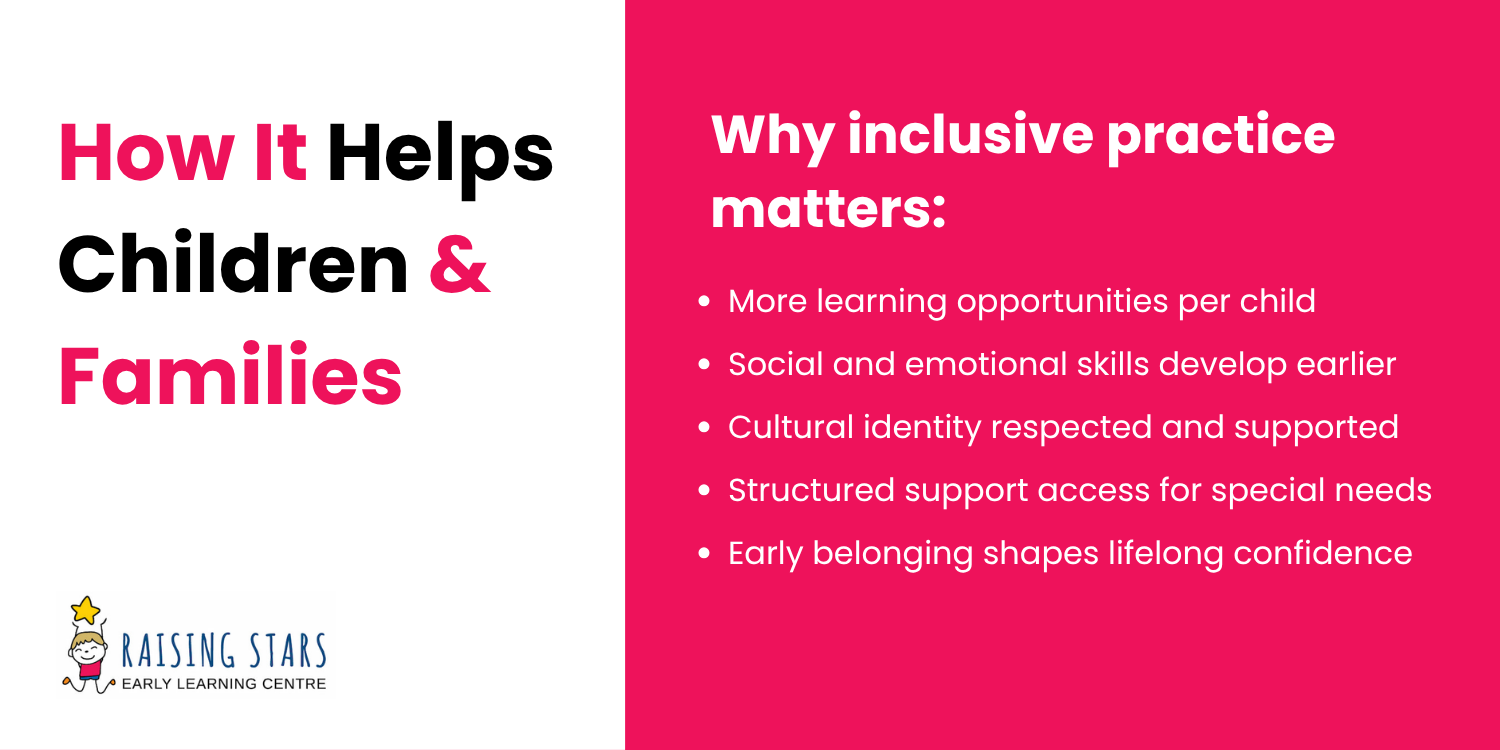
Children in inclusive environments get more opportunities to learn in the way that actually works for them, whether visually, through movement, through play, or through storytelling. Children can also develop social and emotional skills earlier, as inclusive classrooms place deliberate emphasis on collaboration and empathy.
For children with specific needs like a disability or a developmental delay, inclusive practice can be the difference between falling behind and staying engaged.
How inclusive practice helps parents
Families from culturally diverse backgrounds benefit from knowing that their child’s cultural identity is respected and supported in childcare.
For parents with a child with special needs, inclusive practice also means access to structured support. In NSW, the Inclusion Support Programme provides centres with access to resources for educators to provide more appropriate care for children.
Examples of Inclusive Practice in Childcare
Culturally-Sensitive Education
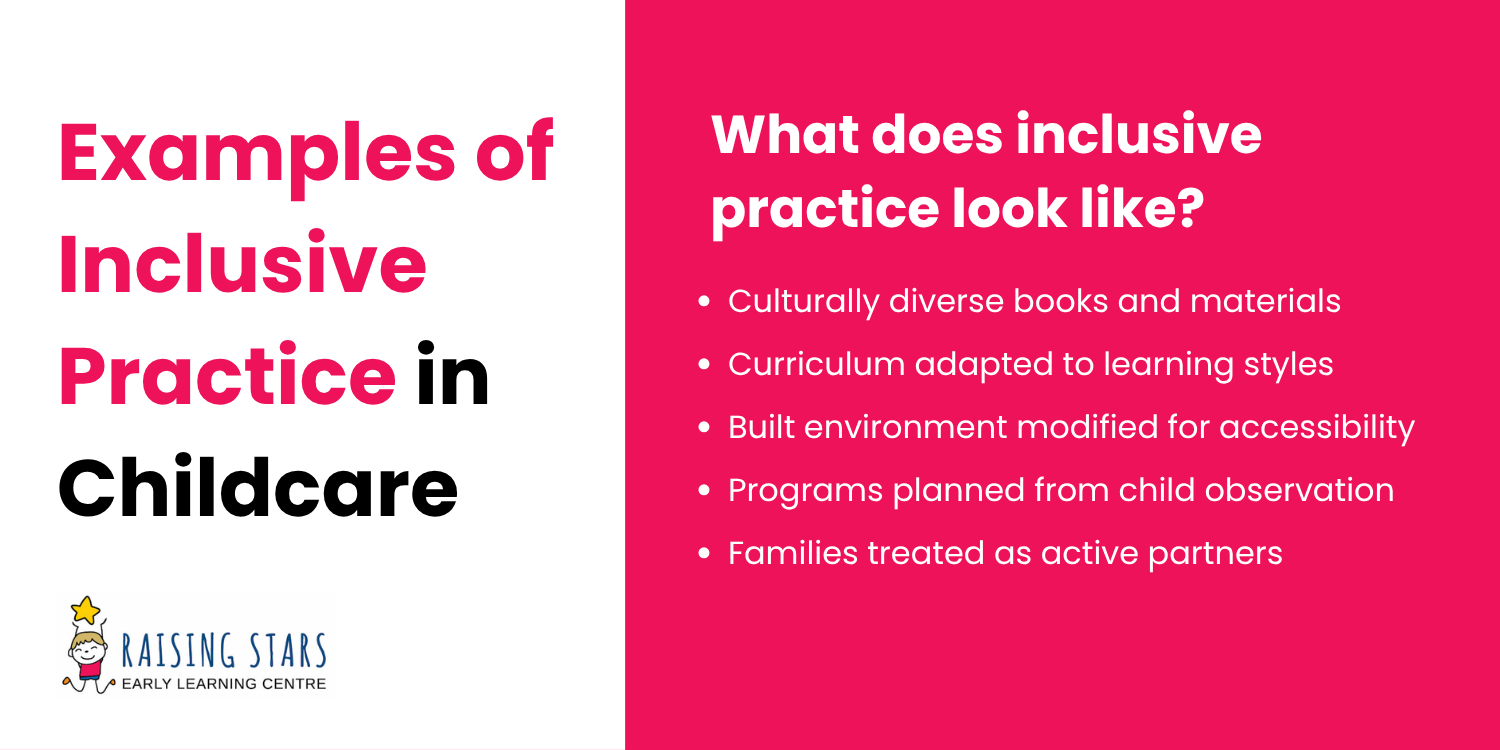
Cultural acceptance is a big focus for inclusive practice. Learning materials such as books, music, and play resources in the room reflect the range of cultural backgrounds present, so every child sees themselves represented. It also means educators take the time to speak with families to understand cultural and religious sensitivities.
Some childcare centres like Raising Stars go one step further to incorporate teaching sessions for languages like Mandarin and Italian to provide a more diverse learning experience for children.
Curriculum adaptation
If a child learns best through movement and handling objects, delivering all instruction verbally can hold them back. Adapting the curriculum means presenting the same concepts through different methods, such as hands-on activities, visual prompts, and storytelling, so the content reaches children in the way they actually absorb it. Most children under five learn best through play, and well-designed programs that are built around play.
Modifications to the built environment
A ramp for a child who uses a wheelchair, a quiet corner for a child with sensory sensitivities, or seating arrangements that allow a child with hearing difficulties to participate fully are all forms of inclusive practice in childcare centres.
Observation-based program planning
Educators who practise inclusion observe children closely and regularly, noting what each child can do rather than focusing on gaps or deficits. Those observations then directly inform how activities are planned, so programming reflects the actual children in the room, not a theoretical average.
Collaboration with families
Parents know their child better than educators do. Good inclusive practice treats families as active partners, gathering information at enrolment, maintaining open communication, and genuinely incorporating what parents share into how their child is supported day to day.
Positive reinforcement
Educators acknowledge effort, offer small choices, and respond warmly to build confidence and help children stay engaged. This approach benefits every child in the room, not just those who are finding things difficult.