
As a parent, it’s only normal to have questions around how early learning educators make decisions around care, learning curriculum, and well-being for your child during their time in childcare.
In Australia, educators at early learning centres use age-appropriate decision-making in line with the Early Years Learning Framework, which is the national standard for childcare education.
What Does Age-Appropriate Decision-Making Mean?
Age-appropriate decision-making is the process of making decisions with consideration to the developmental goals and care needs of each child in line with their age.
Babies and toddlers go through multiple stages of development as they grow, and the focus of each stage changes as children learn, acquire new skills, and become more independent.
Educators apply age-appropriate decision-making to ensure that each child receives the right level of guidance and care to support their growth toward the developmental goals of their age group.
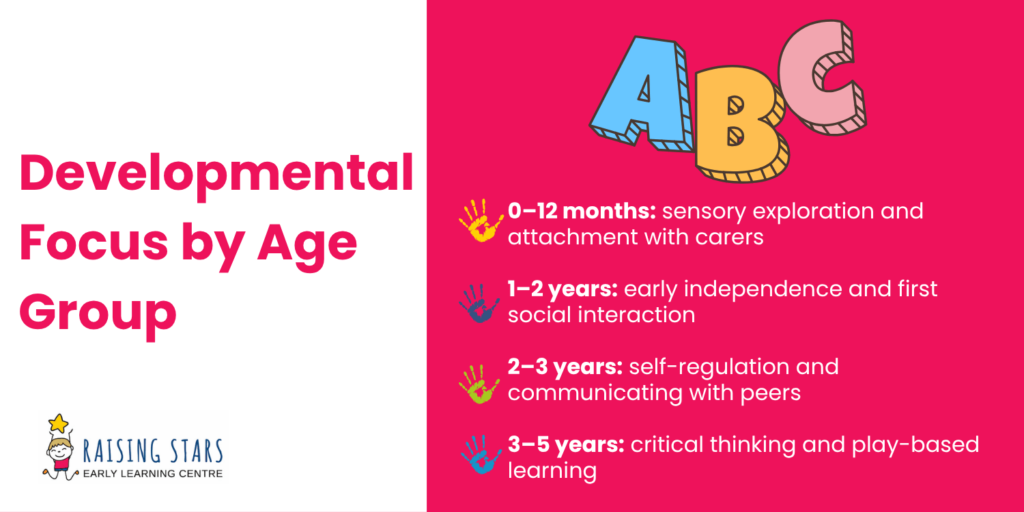
Developmental Focus and Care Needs by Age Group
Babies and Infants (0-12 months)
From birth up to 12 months of age, the developmental focus for babies is limited to sensory learning and exploration. Babies explore their environment through touching, grasping, and biting, while also developing early motor skills through actions like sitting up, rolling, and crawling. Building a sense of attachment and security with carers is also a foundational part of this development stage.
In terms of care needs, newborns and infants will need constant attention for feeding, nappy changes, and sleeping.
Age-appropriate decision-making for babies in a childcare setting involves consistent supervision, providing sensory toys for stimulation, and taking care of physical needs.
Early Toddlers (1-2 years)
Between the ages of 1-2, the developmental focus for children shifts to early independence. Young toddlers are encouraged to accomplish simple tasks on their own, such as holding a spoon when eating or walking from point to point. Sensory and motor skills development continues at this age, with the addition of speaking and listening skills.
During childcare, toddlers up to 2 years old typically get their first exposure to social interaction with other children, albeit not directly. Educators arrange parallel play sessions where young toddlers play independently near their peers, opening up opportunities for sharing and communication.
Toddlers (2-3 years)
Development for toddlers between 2 and 3 years old builds on previous learnings and introduces the concept of self-regulation. Self-regulation includes the ability to recognise physical needs, like being thirsty or needing to go to the toilet, as well as emotions like feeling happy or upset.
Age-appropriate decision-making at this development stage includes group play, where children learn to communicate with peers, develop empathy, and are taught the importance of values like sharing.
Preschool (3-5 years)
Children in preschool are ready for learning at a more complex level – at this stage of development, the focus is on cognitive ability and critical thinking. Through the use of play-based learning approaches, educators promote literacy, numeracy and social skills in childcare prior to the move to primary school.
Educators continue to provide care for preschool-age children for nutrition, hygiene, and safety, but encourage greater independence for simple tasks like putting shoes away, eating, dressing up, and managing personal belongings.
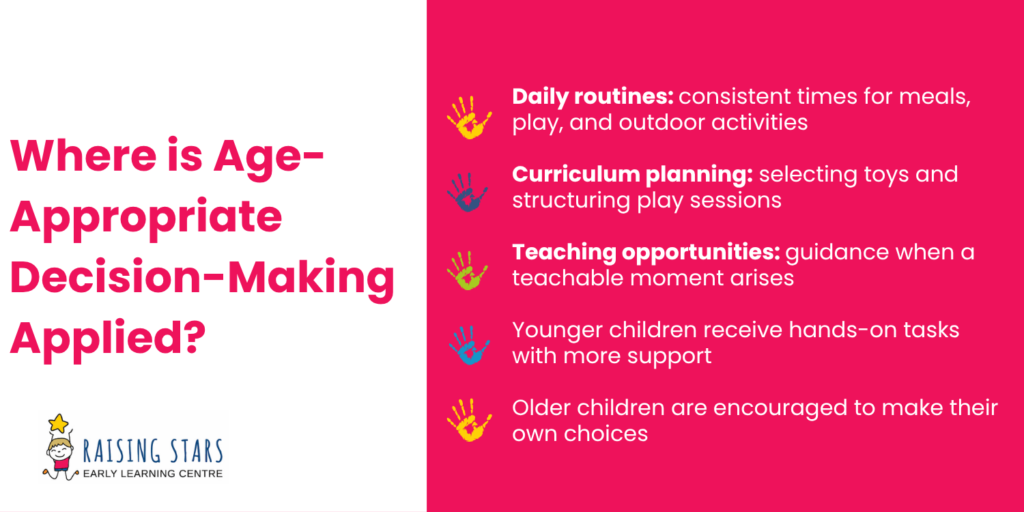
Where Is Age-Appropriate Decision-Making Applied?
Age-appropriate decision-making is applied in early learning centres as part of the intentional teaching process, where every action and decision is made with a clear purpose.
Daily Routines
Educators apply age-appropriate decision-making in the formation of daily routines to build familiarity and confidence in children. An example of this is set times for meals, playtime, and outdoor activities – keeping these times consistent helps children to learn what to expect at different times of the day.
Curriculum Planning
Educators also apply age-appropriate decision-making when planning for activities and play-based learning sessions for each age group. This ranges from intentionally selecting certain types of toys to deciding how structured or free-form a play session should be.
Teaching Opportunities
Educators employ age-appropriate decision-making when they spot a possible teachable moment. Teachers may suggest activities, provide step-by-step guidance, or pull back, depending on the age of the child. Younger children will often get ‘doing’ tasks with more support; whereas preschool-age children will typically get ‘feeling’ tasks which help them make their own choices.